


How Today’s Glasses Can Slow Nearsightedness — Not Just Correct It.
For decades, glasses did one thing for children with myopia: they made vision clearer.
They did nothing to slow the underlying progression of nearsightedness.
That has now changed.
At Helio Optometry, we offer next-generation spectacle lenses specifically designed to both correct vision and slow myopia progression, with results that rival many contact lens or eye-drop treatments.
This represents a major shift in pediatric eye care, especially for families who prefer glasses over contact lenses.
Who Are Myopia Control Glasses For?
Myopia control eyeglasses are most commonly recommended for children who:
Have already been diagnosed with nearsightedness
Show a pattern of increasing prescriptions year over year.
Have a family history of moderate or high myopia.
Spend significant time on near work or screens.
Are not ready or interested in contact lenses
If your child already wears glasses for distance, they may be an ideal candidate for myopia control.
Why Progressive Myopia Deserves Early Attention
Myopia (nearsightedness) is a condition where the eye grows longer than normal, causing distant objects to appear blurry while near vision remains clear.
Importantly, myopia is not just a focusing issue; it is a structural change in the eye.
As myopia progresses, the eye continues to elongate. This excessive eye growth increases a person’s lifetime risk of several serious eye conditions, including:
Cataracts
Retinal detachment
Glaucoma
Myopic macular degeneration
The higher a child’s prescription becomes, the greater these long-term risks.
The goal of modern myopia management is not to eliminate myopia entirely, but to slow its progression. Even reducing myopia progression by 40–60% can meaningfully lower future eye health risks and improve long-term visual outcomes.

How Modern Myopia Control Glasses Actually Work
Traditional single-vision glasses are designed to focus light sharply onto the centre of the retina (the fovea), which provides clear distance vision. However, this design does not influence how light is focused in the peripheral retina. In many cases, peripheral light rays can focus behind the retina, a signal that may encourage the eye to continue elongating as a child grows.
Modern myopia-control spectacle lenses are designed to alter this signal.
These lenses work by creating peripheral myopic defocus, a controlled optical signal that tells the eye to slow its growth, which is the primary driver of worsening nearsightedness.
To achieve this, myopia control lenses use specialized designs, such as concentric rings or tiny lenslets, that create a dual-focus system:
A clear central zone that focuses light accurately on the fovea for sharp distance vision
Surrounding treatment zones that focus peripheral light in front of the retina, creating a “slow-down” or “stop” signal for eye growth
Current research supports this simultaneous myopic defocus mechanism, in which the eye receives both the clear vision signal and the growth-modulating signal simultaneously—during distance and near viewing, throughout the day.
This approach allows children to see clearly while actively reducing the stimulus for continued eye elongation and progressive myopia.
Myopia Control Lenses Available at Helio Optometry
HOYA MiYOSMART — DIMS Technology

HOYA MiYOSMART lenses use Defocus Incorporated Multiple Segments (DIMS) technology, developed in collaboration with the Hong Kong Polytechnic University and supported by some of the longest-term clinical data available for spectacle-based myopia control.
Each lens is designed with:
A 9 mm clear central zone for sharp distance vision
A surrounding treatment zone made up of hundreds of small +3.50D lenslets
This design allows MiYOSMART lenses to correct vision normally while simultaneously creating a consistent myopia-slowing signal across the retina throughout the day.
Clinical studies demonstrate:
Approximately 50–60% reduction in myopia progression
Approximately 60% reduction in axial eye growth
Strong safety data with no rebound effect after discontinuation
Sustained effectiveness shown in studies lasting six years and beyond
Essilor Stellest — H.A.L.T. Technology
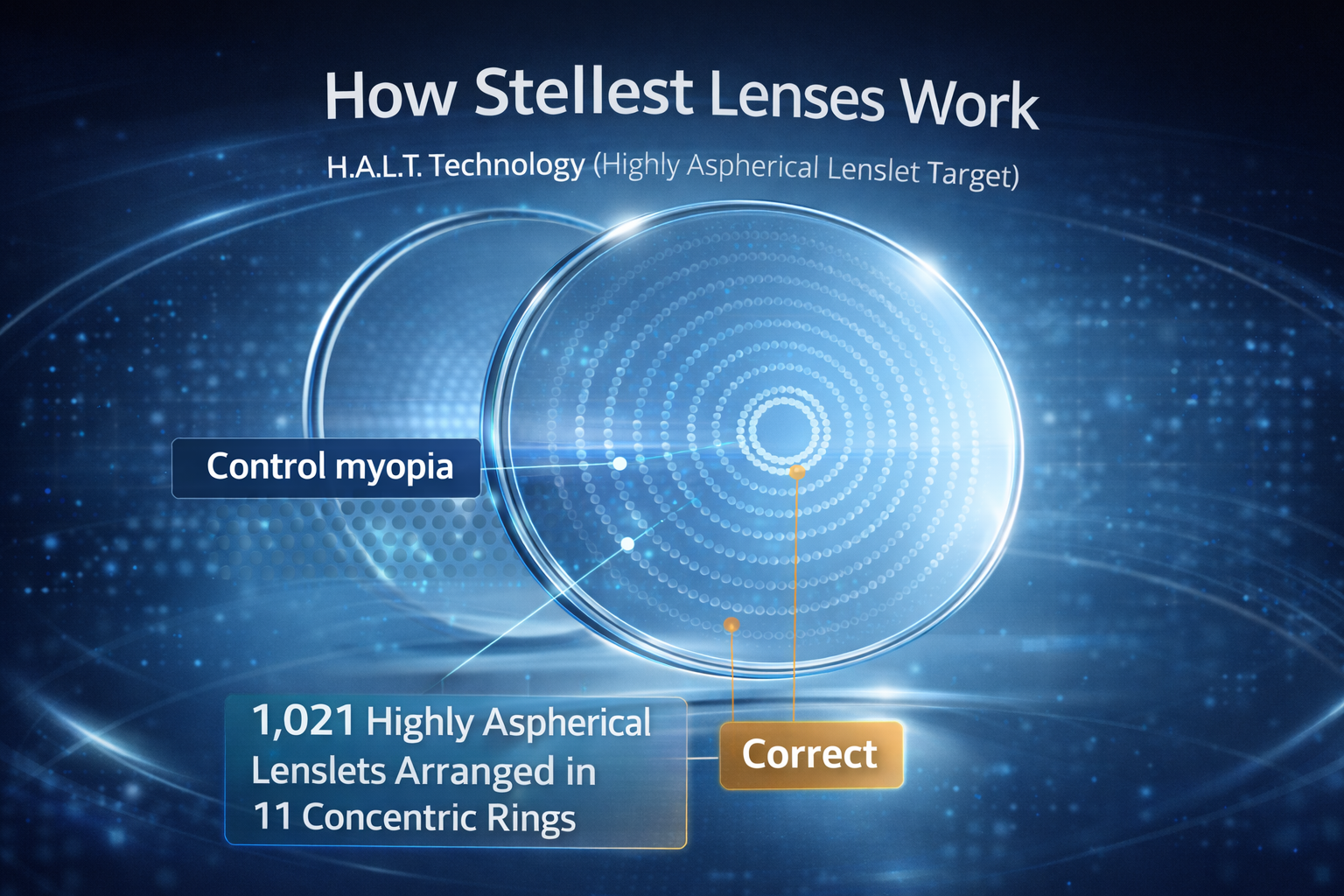
Essilor Stellest lenses are designed using H.A.L.T. technology (Highly Aspherical Lenslet Target), Essilor’s proprietary optical system developed specifically for myopia control in children.
H.A.L.T. technology works by incorporating 1,021 highly aspherical lenslets arranged in 11 concentric rings around a clear central zone. Rather than creating a single plane of defocus, these lenslets generate a three-dimensional “volume of myopic defocus” in front of the retina. This volume acts as a sustained biological signal that helps slow excessive eye growth while maintaining clear central vision.
Clinical outcomes show:
Approximately 55% reduction in myopia progression
Approximately 50% reduction in axial eye growth
Up to 67% effectiveness when worn at least 12 hours per day
Five-year data demonstrating a reduced incidence of high myopia, with longer-term data continuing to emerge
What These Lenses Have in Common
Although the technology behind these lenses is sophisticated, the experience for children is simple.
Both MiYOSMART and Stellest lenses share key design features:
A clear central viewing zone for sharp distance vision
Surrounding treatment zones that influence eye growth
Vision quality similar to standard single-vision lenses
No interference with focusing or eye teaming
Worn and cared for just like regular glasses
From a parent’s perspective, this means no drops, no contacts, and no complicated routines—just consistent wear.
MiYOSMART vs Stellest — Which Is Better?
From a clinical perspective, there is no clear evidence that one of these lenses is universally superior to the other.
Both MiYOSMART and Stellest are supported by high-quality randomized clinical trials, consistently slow myopia progression by approximately 50% or more, and provide clear, comfortable vision for everyday wear. In routine clinical practice, their overall effectiveness is very similar.
For this reason, the most important factor is often access—choosing a proven myopia control lens that is available, properly fitted, and worn consistently.
In the uncommon situation where a child experiences visual discomfort or adaptation issues with one design, switching to the other lens is a straightforward and effective alternative.
Why You May Not Have Heard About These Lenses Before?
Myopia control is a rapidly evolving area of eye care.
While the prevalence and risks of progressive myopia are now well established, the research supporting modern treatment options — particularly spectacle-based myopia control lenses — has advanced significantly only in recent years. As a result, not all practitioners may feel fully comfortable discussing newer myopia control strategies if this is not a primary focus of their clinical practice.
In addition, access to myopia control lenses can be limited in some settings, especially where product offerings are standardized or where clinics are not structured to support ongoing myopia monitoring.
At Helio Optometry, myopia management is an intentional area of focus. We stay current with emerging research, track myopia progression over time, and integrate evidence-based treatment options early, before prescriptions increase unnecessarily and long-term risk escalates.
Glasses Are Now a First-Line Myopia Treatment
Advances in lens design have changed the role of glasses in pediatric myopia care.
For the first time, spectacle lenses are not only used to correct vision, but can also play an active role in slowing myopia progression. This has made glasses a practical and effective first-line treatment option for many children.
For families, myopia control glasses offer several advantages:
A low-risk and non-invasive entry point into myopia management
An effective alternative for children who are not ready for contact lenses
A treatment option that integrates easily into daily routines
Rather than simply observing prescription changes over time, myopia control offers a proactive, evidence-based approach to protecting long-term eye health.
Are Myopia Control Glasses the Only Treatment?
No, myopia control glasses are often one part of a broader myopia management plan.
The most appropriate approach depends on a child’s age, rate of progression, prescription changes over time, and everyday visual habits. In addition to spectacle-based myopia control, management may also include:
Guidance on lifestyle factors such as outdoor time and healthy near-work habits
Regular monitoring of prescription changes and eye growth over time
Ongoing reassessment and consideration of other treatment options if needed in the future
For many children, myopia control glasses are an ideal first step, effective, non-invasive, and easy to integrate into daily life, while still allowing flexibility to adjust the treatment plan as the child’s eyes develop.
Book a Myopia Control Assessment at Helio Optometry
If your child is already wearing glasses for nearsightedness and their prescription continues to increase, early intervention becomes especially important. Myopia progression does not need to be passively observed.
A myopia control assessment at Helio Optometry includes:
A detailed review of your child’s prescription history
Evaluation of myopia progression patterns
Discussion of evidence-based myopia control options
Personalized lens recommendations
Ongoing monitoring and long-term management planning
Myopia progression can be slowed, and earlier intervention leads to better long-term outcomes for both vision and eye health.
If your child has been diagnosed with myopia, or if their prescription has changed over the past year, now is the right time to have this conversation.

Disclaimer: The content provided in this blog post by Helio Optometry eye care clinic in West Edmonton is intended solely for informational purposes and does not replace professional medical advice, diagnosis, or treatment by a Licensed Optometrist. No doctor/patient relationship is established through the use of this blog. The information and resources presented are not meant to endorse or recommend any particular medical treatment or guarantee and outcome. Readers must consult with their own healthcare provider regarding their health concerns. Helio Optometry and its optometrists do not assume any liability for the information contained herein nor for any errors or omissions. Use of the blog's content is at the user's own risk, and users are encouraged to make informed decisions about their health care based on consultations with qualified professionals.




Somewhere around your 40s, your eyes stop doing three things at once, and most people just live with it. Here's the fix most places never actually get right, and why Stonewire builds every lens around how you really live, not just what your prescription says.