


Reviewed by Dr. Ross McKenzie, Optometrist | Helio Optometry | Edmonton, Alberta | November 2026
Quick Answer: What Causes Bright Zigzag Lines in Your Vision?
Bright, shimmering, or zigzag lines that appear suddenly in your vision and disappear after 20 to 30 minutes are often symptoms of a visual migraine aura. These disturbances can look like flashing lights, colourful kaleidoscope patterns, wavy lines, or expanding blind spots. Interestingly, they can occur without a headache.
Although migraine auras are often harmless, new visual disturbances should be evaluated by an optometrist to help rule out other eye or neurological conditions. Sudden vision loss or certain accompanying symptoms may require emergency medical attention.
You’re Working at Your Computer, and Suddenly Something Looks Strange
Imagine sitting at your computer, answering emails, when something unusual catches your attention.
A small, shimmering spot appears near the centre of your vision. At first, you think it’s a reflection on your screen. But then it starts growing.
Within minutes, you’re seeing bright zigzag lines, almost like a colourful lightning bolt moving across your vision. Parts of the words on your screen seem to disappear. You try looking away, blinking, or rubbing your eyes, but nothing helps.
Then, about 30 minutes later, everything returns to normal.
What just happened? And should you be worried?
At Helio Optometry in Edmonton, we see patients describing these exact symptoms a few times every month. Some report bright, wavy lines. Others describe rainbow-coloured patterns, flashing lights, or a blurry patch that seems to move across their vision.
One possible explanation is something called a migraine with visual aura.
What Is a Visual Migraine Aura?
A visual migraine aura is a temporary disturbance in vision caused by changes in electrical activity in the brain’s visual processing areas.
Despite what many people assume, the problem doesn’t necessarily originate in your eyes.
During a visual aura, a wave of altered electrical activity moves across the visual cortex, the part of your brain that processes what you see. This phenomenon is known as cortical spreading depression.
Fortunately, you don’t need to remember that term.
The important thing to understand is that your eyes may be working normally, but your brain is temporarily processing visual information differently.
What Does a Migraine Aura Look Like?
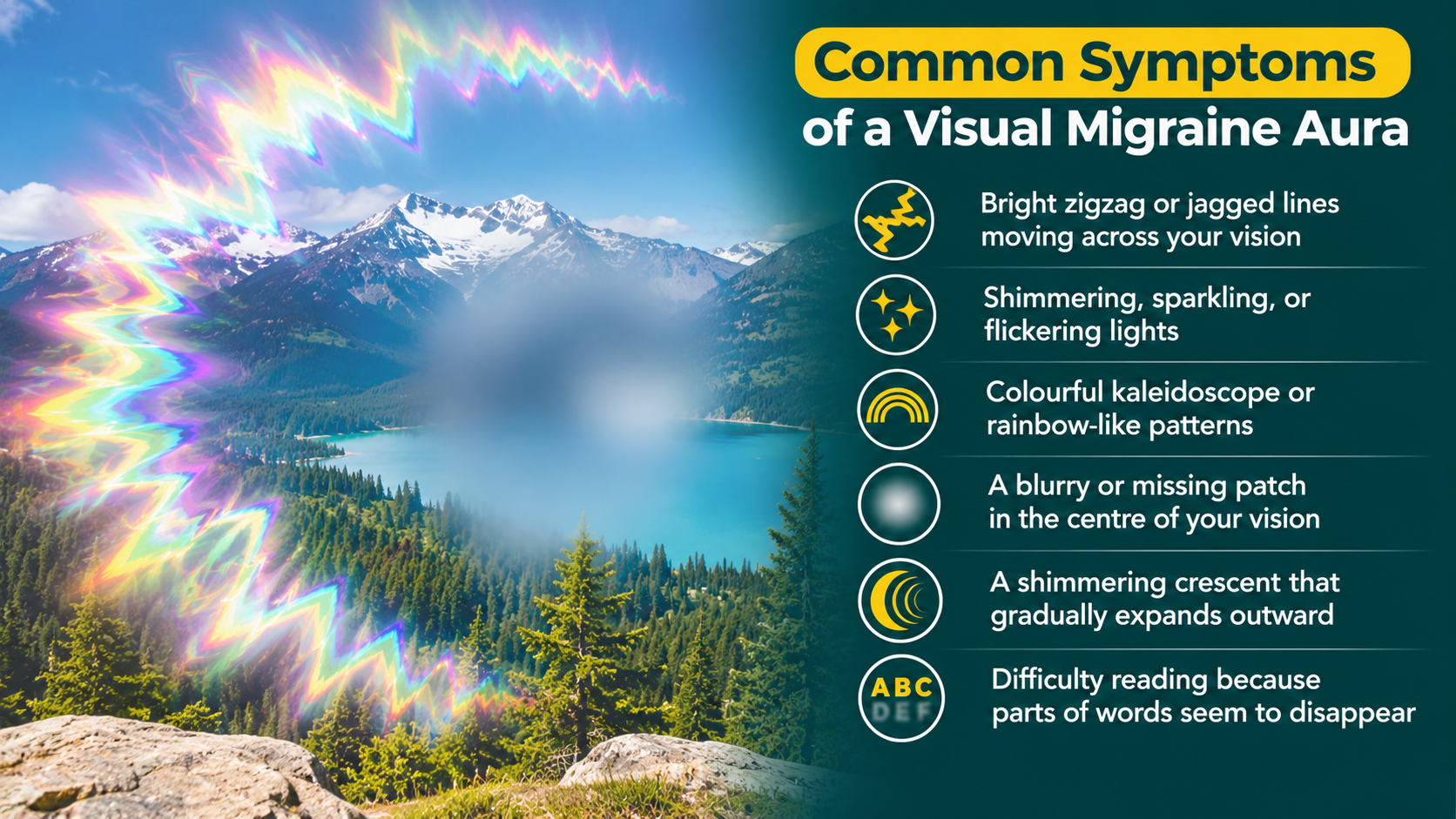
Patients describe visual migraine symptoms in surprisingly different ways, including:
Bright zigzag or jagged lines moving across their vision
Shimmering, sparkling, or flickering lights
Colourful kaleidoscope or rainbow-like patterns
A blurry or missing patch in the centre of their vision
A shimmering crescent that gradually expands outward
Difficulty reading because parts of words seem to disappear
One particularly common description is a shimmering, zigzag pattern that slowly grows and moves toward the edge of your vision.
This is sometimes called a fortification spectrum, because the jagged pattern resembles the walls of an old fortress.
The visual disturbance can be distracting, especially when you’re trying to read, drive, or work on a computer.
Can You Have a Migraine Aura Without a Headache?
Absolutely. And this often surprises our patients.
When most people think of migraines, they imagine a severe, throbbing headache, sometimes accompanied by nausea or sensitivity to light.
But migraine auras don’t always follow that pattern.
Some people experience visual disturbances followed by a headache. Others experience the visual symptoms and never develop a headache at all.
This is sometimes called a silent migraine or typical aura without headache.
In our Edmonton optometry clinic, we occasionally see patients who have experienced these visual disturbances without ever having what they would consider a traditional migraine headache.
For some, the experience is completely new. Others tell us they’ve had similar episodes periodically for years.
The absence of a headache doesn’t automatically mean the episode was harmless, particularly if it’s the first time you’ve experienced these symptoms.
How Long Do Visual Migraine Symptoms Last?
One of the most important questions we ask patients is surprisingly simple:
“How long did it last, and has your vision returned completely to normal?”
A typical visual migraine aura develops gradually over several minutes and usually lasts between 5 and 60 minutes.
Many patients describe episodes lasting approximately 20 to 30 minutes.
The progression often follows a recognizable pattern:
A small shimmering spot or visual distortion appears.
The pattern gradually grows or spreads across the visual field.
Zigzag lines, flashing lights, or a blind spot become more noticeable.
The disturbance slowly fades.
Vision returns to normal, sometimes followed by a headache.
The timeline helps us distinguish a typical migraine aura from other potential causes of visual disturbances.
Symptoms that appear instantly, persist, or involve sudden vision loss deserve particular attention.
If your vision hasn’t returned to normal, don’t simply wait for the symptoms to disappear. Seek urgent medical assessment.
Is the Visual Disturbance in One Eye or Both Eyes?
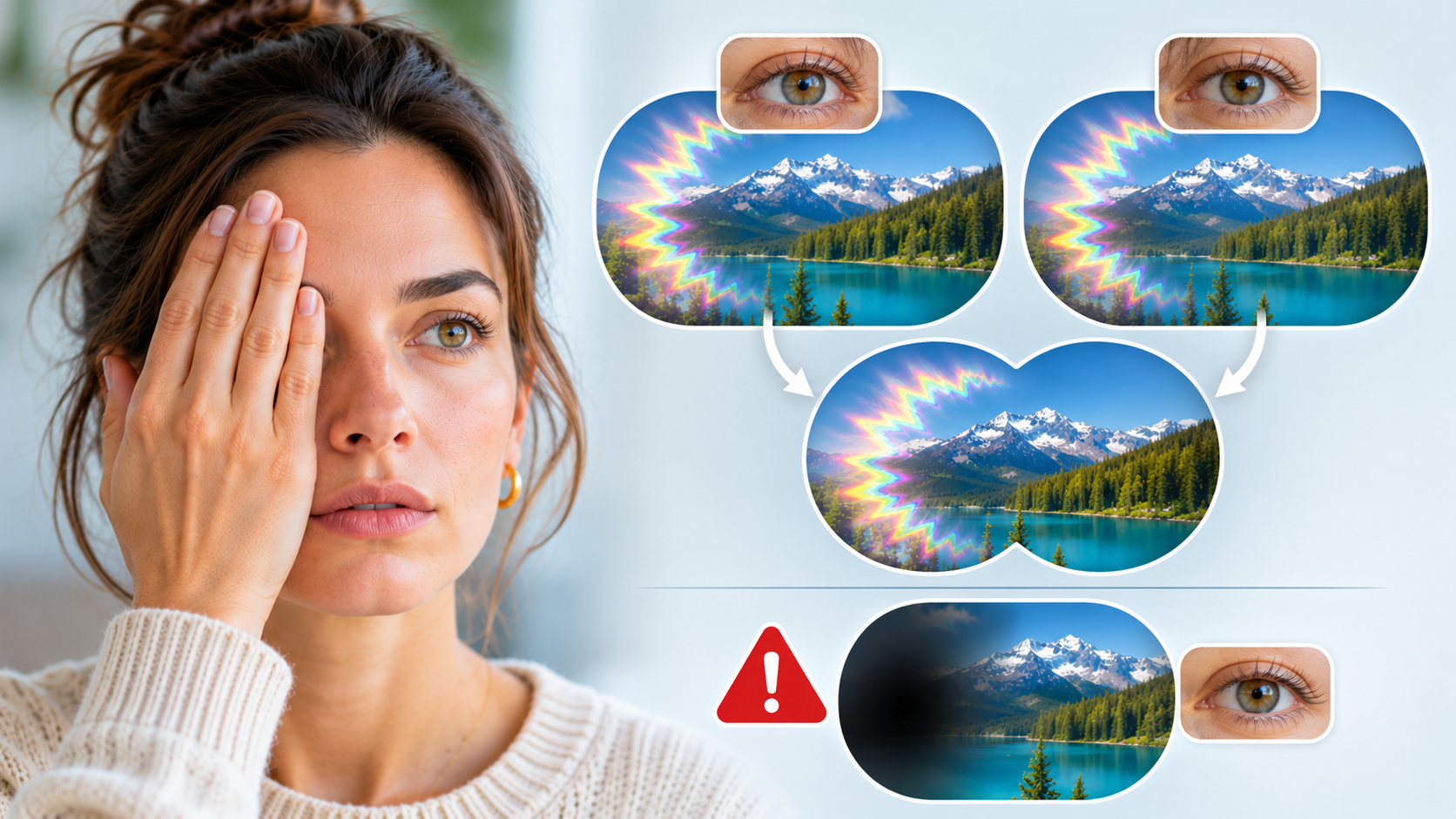
This is another important distinction.
A typical visual migraine aura originates in the brain and generally affects the same area of the visual field in both eyes.
However, many patients initially believe the disturbance is happening in just one eye.
That’s because the shimmering pattern might appear off to the left or right side of their vision, creating the impression that only one eye is affected.
If an episode occurs and you can safely check, try covering one eye and then the other.
If the same visual disturbance remains visible in the same part of your visual field with either eye open, that pattern may be consistent with a visual migraine aura.
If the disturbance is genuinely present in only one eye, other causes need to be considered.
Important: Sudden vision loss in one eye can indicate a serious retinal or vascular condition. It should never automatically be dismissed as an ocular migraine.
Is It a Migraine Aura or Something More Serious?
Although bright, shimmering zigzag lines are commonly associated with visual migraine auras, not every visual disturbance is a migraine.
Other conditions, including retinal tears, retinal detachments, and problems with blood flow to the eye or brain, can produce similar symptoms. Knowing when to seek medical attention is important.
When Should You Seek Emergency Medical Attention?
Certain visual symptoms deserve immediate attention, particularly if they appear suddenly or are different from anything you’ve experienced before.
Call 911 immediately if you experience:
Sudden loss of vision in one or both eyes
Vision changes accompanied by weakness, facial drooping, difficulty speaking, or confusion
Sudden double vision, particularly with dizziness or difficulty walking
A sudden, extremely severe headache
New flashing lights, particularly when accompanied by floaters, or a dark curtain or shadow moving across your vision, require urgent assessment by an optometrist or ophthalmologist to rule out a retinal tear or detachment.
Your optometrist is often the best first point of contact, as they can examine your retina and arrange an urgent referral to a retinal specialist if necessary. If you cannot access urgent eye care, seek assessment at an emergency department without delay.
Could It Be a Stroke? Remember FAST
A stroke or transient ischemic attack (TIA), sometimes called a mini-stroke, can occasionally cause visual symptoms.
The FAST checklist is a simple way to recognize common stroke warning signs:
F: Face. Is one side of the face drooping?
A: Arms. Is there sudden weakness or numbness in one arm?
S: Speech. Is speech slurred or difficult to understand?
T: Time. Call 911 immediately if you notice any of these symptoms.
Remember that strokes can also cause sudden vision loss or balance problems without the classic FAST symptoms. In fact, many places are now adopting a newer BE FAST checklist.
B: Balance. Sudden loss of balance or coordination, difficulty walking, or unexplained dizziness or vertigo (feeling like the room is spinning).
E: Eyes. Sudden loss of vision in one or both eyes, double vision, or difficulty seeing to one side.
Even if your symptoms disappear completely, possible stroke symptoms require emergency medical assessment.
A typical visual migraine aura usually develops gradually, with shimmering patterns that expand over several minutes before disappearing. However, the timing and appearance of symptoms alone cannot reliably rule out more serious conditions.
If you’ve experienced a new visual disturbance without emergency warning signs, a prompt eye examination at Helio Optometry can help determine whether additional testing or medical evaluation is needed.
How Does Helio Optometry Investigate Visual Migraine Symptoms?
When someone visits Helio Optometry describing bright zigzag lines, flashing lights, or a temporary loss of vision, our priority is understanding exactly what happened.
As an optometrist, I find that the patient’s description and the timeline of their symptoms are often just as important as the examination itself.
I want to know:
Did the visual disturbance appear suddenly or gradually?
Did it expand or move across your vision?
Did it last five minutes, half an hour, or several hours?
Was it present in one eye or both?
Did you develop a headache or other symptoms?
Most importantly, has your vision completely returned to normal?
These details help determine what testing is appropriate and whether urgent medical evaluation is necessary.
Advanced Eye Testing at Helio Optometry
Depending on your symptoms and examination findings, we may recommend several diagnostic tests.
Optomap Ultra-Widefield Retinal Imaging (OPTOS): Our Optomap technology captures a widefield image of the retina, helping us assess retinal health and identify abnormalities that may contribute to visual symptoms.
Optical Coherence Tomography (OCT): OCT provides detailed cross-sectional images of the retina, allowing us to examine its individual layers and investigate certain retinal conditions that may affect vision.
Virtual Reality Visual Field Testing (VR): We also use modern virtual reality visual field technology to help us assess different areas of your peripheral and central visual field. This can be particularly helpful when investigating unexplained visual disturbances or looking for patterns of visual field loss that may suggest retinal, optic nerve, or neurological concerns.
Not every person needs every test. Our examination is tailored to your symptoms, medical history, and clinical findings.
It’s also important to understand that retinal imaging and visual field testing cannot, on their own, confirm a migraine aura or rule out every neurological condition. When appropriate, we’ll recommend further assessment through your family physician or emergency medical services.
What Triggers a Visual Migraine Aura?
One of the most common questions patients ask is whether something they were doing caused the episode.
Sometimes, migraine auras occur without an obvious trigger.
For others, potential triggers may include stress, changes in sleep, dehydration, missed meals, hormonal fluctuations, or bright, flickering lights.
Computer screens are frequently mentioned because many patients first notice their symptoms while working.
However, experiencing a migraine aura while using a computer doesn’t necessarily mean the screen caused it.
If episodes become recurrent, keeping a record of when they happen, how long they last, and what you were doing beforehand may help identify patterns.
Frequently Asked Questions About Zigzag Lines and Visual Migraines
-
Bright, shimmering zigzag lines that gradually expand and disappear within 5 to 60 minutes can be a symptom of a visual migraine aura. However, other eye and neurological conditions can produce similar symptoms, so new episodes deserve medical evaluation.
-
Kaleidoscope vision describes colourful, fragmented, or shimmering patterns that appear in your visual field. A visual migraine aura is one possible cause, particularly when the pattern develops gradually and resolves within approximately 30 minutes.
-
Yes. Some people experience a visual migraine aura without developing a headache. This is often called a silent migraine. The term ocular migraine is used inconsistently, so it’s important to distinguish a typical visual aura from symptoms affecting only one eye.
-
Not always. Flashing or shimmering lights can occur during migraine auras, but they can also be associated with retinal tears, retinal detachment, or other conditions. New flashes, especially with floaters, shadows, or vision loss, require urgent evaluation.
-
Stress and certain visual stimuli may trigger migraines in susceptible individuals. However, a visual aura that begins while using a computer isn’t necessarily caused by screen time.
-
Yes, particularly if this is your first episode. Even when vision returns to normal, an eye examination and medical history review can help identify potential causes and determine whether further investigation is needed.
-
No. If you're experiencing flashing lights, blind spots, or distorted vision, you should avoid driving until your vision has completely returned to normal.
If symptoms begin while you're driving, pull over somewhere safe. If you experience sudden vision loss or symptoms suggesting a stroke, call 911 immediately.
Even if your symptoms disappear completely, a new or unexplained episode should be medically assessed before you resume driving.
Seeing Bright Zigzag Lines or Flashing Lights? Let’s Find Out Why.
If you’ve experienced bright, wavy lines, flashing lights, or kaleidoscope-like patterns in your vision, you’ve probably been wondering what caused them.
While these symptoms are often associated with visual migraine auras, we should never assume that a migraine is the cause simply because the symptoms sound familiar.
A visual migraine aura is primarily diagnosed based on your symptoms and medical history, but it’s important to investigate and rule out other potential causes when appropriate.
At Helio Optometry in Edmonton, we start by listening to your symptoms, understanding how they developed, and performing a comprehensive eye examination. When appropriate, we use advanced diagnostic technology, including Optomap retinal imaging, OCT, and virtual reality visual field testing, to help investigate possible eye-related causes.
Sometimes, the findings are reassuring and the symptoms are consistent with a visual migraine aura. Other times, further medical or neurological investigation may be necessary.
The important thing is knowing the difference.
If you’ve recently experienced unexplained visual disturbances, even if your vision has completely returned to normal, we encourage you to arrange an eye examination.
Book your eye exam at Helio Optometry in Edmonton and take the first step toward understanding what’s happening with your vision.
Sudden vision loss or symptoms suggestive of a stroke require emergency medical attention. Call 911 rather than waiting for an eye appointment.

Disclaimer: The content provided in this blog post by Helio Optometry eye care clinic in West Edmonton is intended solely for informational purposes and does not replace professional medical advice, diagnosis, or treatment by a Licensed Optometrist. No doctor/patient relationship is established through the use of this blog. The information and resources presented are not meant to endorse or recommend any particular medical treatment or guarantee and outcome. Readers must consult with their own healthcare provider regarding their health concerns. Helio Optometry and its optometrists do not assume any liability for the information contained herein nor for any errors or omissions. Use of the blog's content is at the user's own risk, and users are encouraged to make informed decisions about their health care based on consultations with qualified professionals.




Seeing bright zigzag lines, flashing lights or kaleidoscope vision? Learn about migraine auras, warning signs and when to book an eye exam in Edmonton.