


Myopia Management for
Children in Edmonton
Modern myopia management can help slow the progression of nearsightedness and protect your child's long-term eye health.
Your Child's Eyes Are Growing. Their Nearsightedness Doesn't Have to Keep Getting Worse.
Another year. Another eye exam. Another stronger pair of glasses.
If your child's eyeglass prescription seems to get stronger every year, you're not alone. Many parents assume that worsening nearsightedness is simply part of growing up.
But what if there was something we could do to slow it down?
At Helio Optometry in Edmonton, we offer specialized myopia management treatments designed to slow the progression of childhood nearsightedness. Our goal isn't just to help your child see clearly today. It's to help protect their vision for all the years ahead.
Because while we can't stop children from growing up, we can often help slow how quickly their nearsightedness progresses.

What Is Myopia?
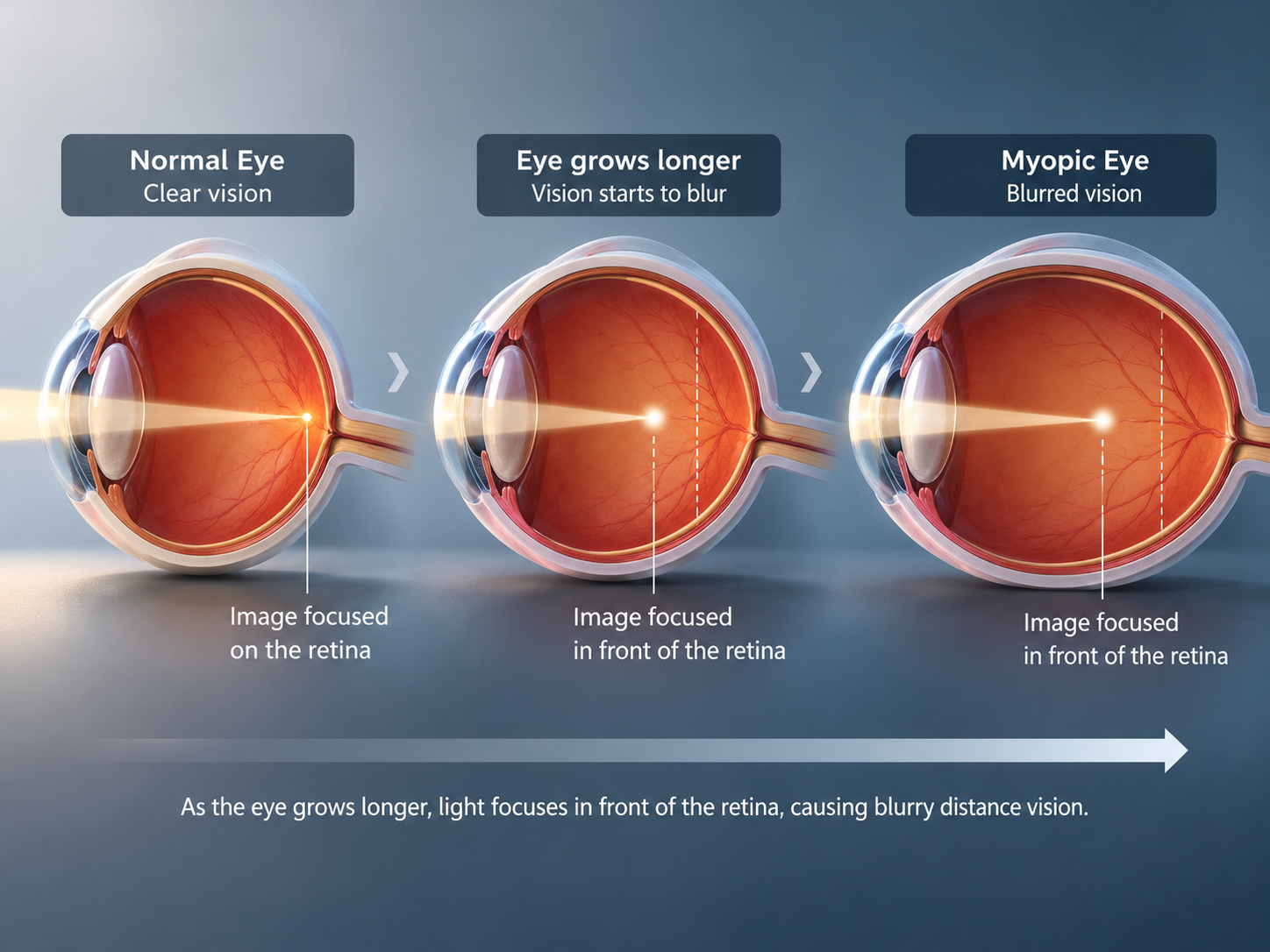
Myopia—commonly called nearsightedness—means distant objects appear blurry while near vision remains clear. In children, myopia is not just a focusing issue; it is most often caused by excessive eye growth.
A myopic eye grows longer than normal, causing light to focus in front of the retina instead of directly on it. This condition is known clinically as axial elongation, and it is the key reason myopia carries long-term eye health risks.
Important distinction:
Glasses and standard contact lenses correct blurred vision but they do not slow eye growth.
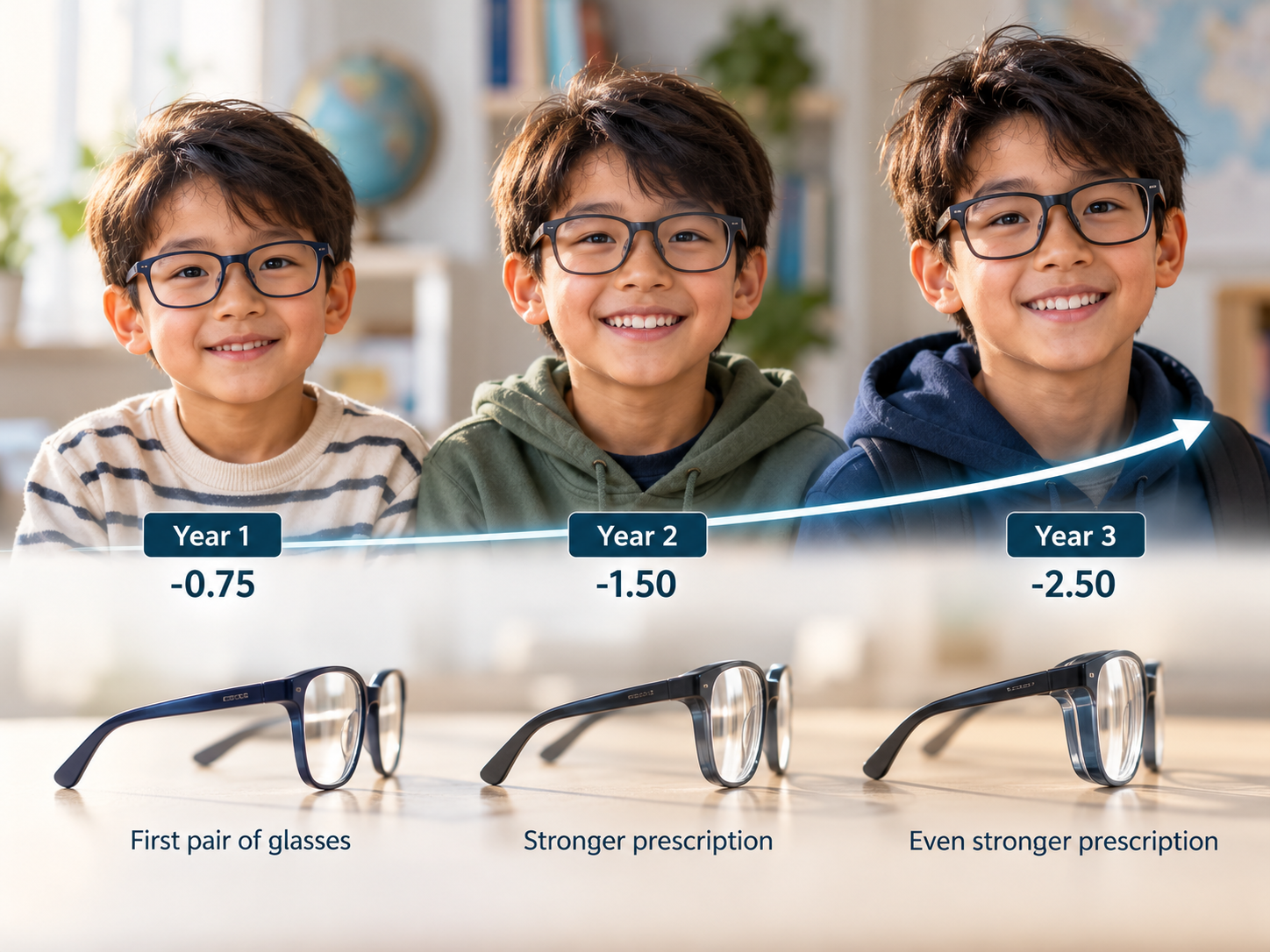
Stronger Glasses Every Year? Here's What Parents Should Know.
Think back to when your child got their first pair of glasses.
Maybe they were struggling to see the board at school. Maybe you noticed them squinting at the television. Or perhaps their nearsightedness was discovered during a routine eye examination.
Their new glasses made everything clear again, and you probably thought the problem was solved.
Then, a year later, their prescription had changed.
And perhaps the year after that, it changed again.
Here's what many parents don't realize: traditional glasses correct blurry vision, but they don't do much to slow the progression of childhood nearsightedness.
When children become nearsighted, it's usually because their eyes are growing too long from front to back. As their eyes continue to grow, their prescription can become increasingly stronger.
For years, the usual approach was simply to update their glasses whenever their vision changed.
Today, we have better options.
Modern myopia management treatments can help slow the progression of nearsightedness during the years when children's eyes are still developing.
And the earlier we recognize the problem, the more opportunity we may have to make a meaningful difference.
What Is Myopia Management?
Helping Children See Clearly Today, While Looking After Their Tomorrow.
Myopia is the medical term for nearsightedness. It means your child can usually see nearby objects clearly, but things farther away appear blurry.
For a child, that might mean struggling to read the classroom board, recognize a friend across the playground, or follow the puck during a hockey game.
Glasses or contact lenses can correct that blurry vision.
Myopia management goes one step further.
Rather than simply correcting your child's vision, myopia management uses specialized treatments designed to slow the excessive eye growth responsible for increasing nearsightedness.
Our goals are simple:
Help your child see clearly and confidently. Whether they're learning in the classroom, playing sports, or exploring the world around them, good vision matters.
Help reduce how nearsighted they become as adults. By slowing myopia progression during childhood, we aim to reduce the strength of their eventual prescription and the eye health risks associated with higher levels of myopia.
We can't promise that your child's prescription will stop changing. But with the right treatment, we may be able to slow how quickly it changes.
And over several years of childhood, that difference can matter.
What Can We Do to Slow Your Child's Nearsightedness?
More Options Than Simply Prescribing Stronger Glasses.
Every child is different.
Some children love wearing glasses. Others are constantly taking them off. Some are active in sports, while others spend more time reading, drawing, or working on school projects.
Their age, prescription, rate of progression, and daily activities all matter when choosing a treatment.
At Helio Optometry, we offer several proven myopia management options so we can recommend an approach that makes sense for your child and your family.
-
Atropine Eye Drops
A simple, once-daily treatment that may help slow your child's worsening nearsightedness.
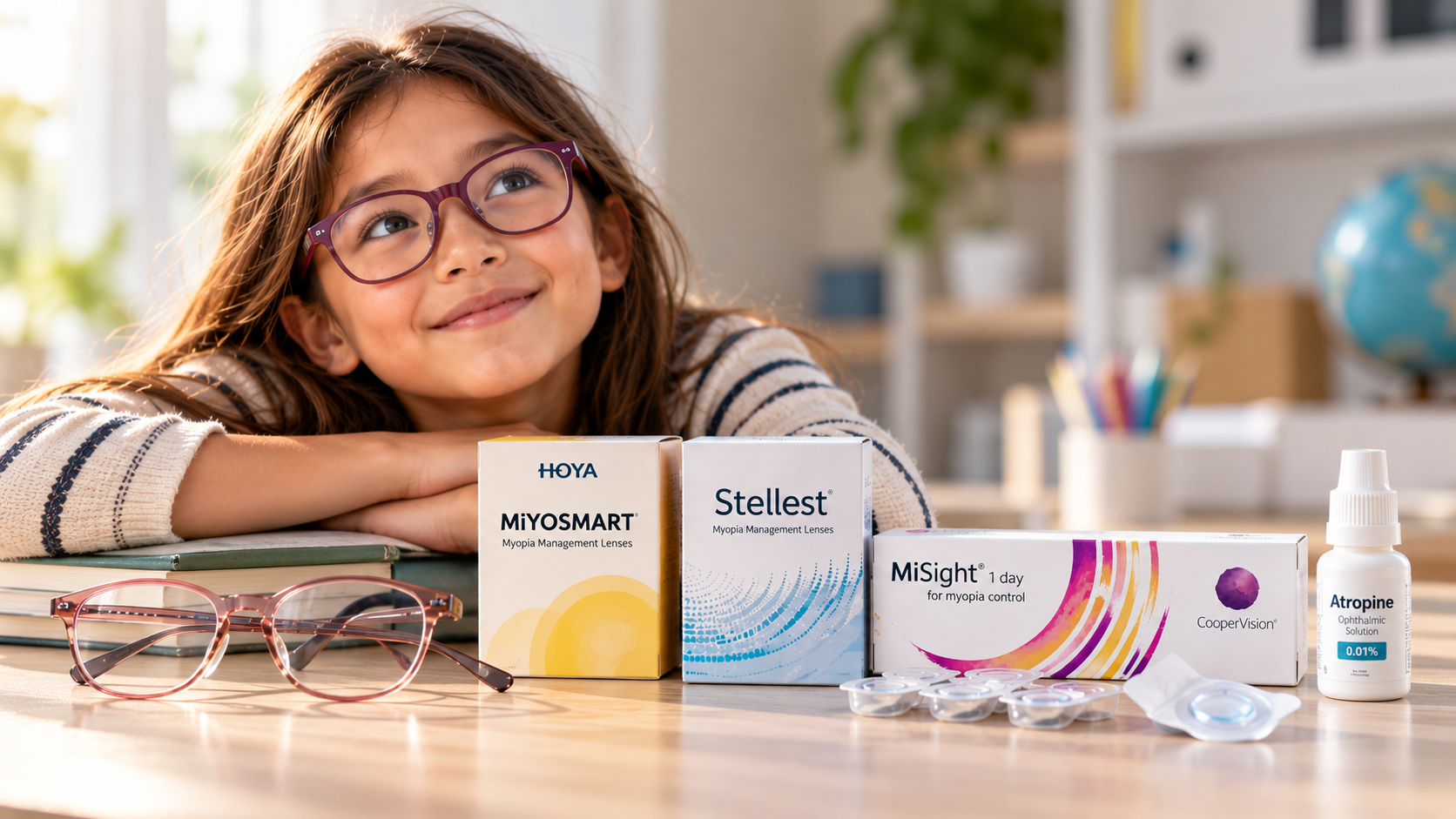
Low-dose atropine eye drops are one option for managing childhood myopia. Although atropine has been used in eye care for many years, research has shown that certain concentrations can also help slow the progression of nearsightedness in children.
Atropine is available in different concentrations, with lower doses, typically between 0.01% and 0.05%, commonly used for myopia management. The effectiveness of treatment varies by concentration, with 0.05% generally showing stronger results than 0.01% in clinical studies.
The drops are usually applied once daily, often at bedtime. Because atropine does not correct blurry distance vision, your child will still need their regular glasses or contact lenses.
At Helio Optometry, we can help determine whether atropine is appropriate for your child, select a suitable concentration, and monitor their response over time.
Is Atropine Right for My Child?
Easy to incorporate into a daily routine. Atropine is typically administered as one drop in each eye at bedtime.
Suitable for a range of prescriptions. Atropine may be considered for children with mild, moderate, or higher levels of myopia, depending on their individual needs.
Generally well tolerated. Most children tolerate low-dose atropine well, although some may experience light sensitivity, glare, or difficulty focusing on nearby objects. Side effects tend to become more common at higher concentrations.
Can be combined with other treatments. In certain cases, atropine may be used alongside myopia management eyeglasses or contact lenses, particularly when myopia continues to progress.
Requires ongoing monitoring. Some children experience faster myopia progression after stopping atropine, sometimes called a rebound effect. We'll help determine when and how treatment should be discontinued.
Not every child responds the same way. The appropriate concentration depends on factors such as age, progression rate, treatment response, and tolerance.
-
Glasses that do more than help your child see clearly. They can also help slow their worsening nearsightedness.
For years, when a child's nearsightedness increased, the solution was simply to prescribe stronger glasses. While traditional eyeglasses correct blurry vision, they do little to slow the progression of myopia.
Today, specialized myopia management eyeglasses offer families a better option.
At Helio Optometry, we offer two leading myopia management spectacle lenses: HOYA MiYOSMART and Essilor Stellest. Both use innovative optical technologies designed to provide clear vision while helping slow the excessive eye growth responsible for worsening nearsightedness.
Clinical studies have demonstrated that these specialized lenses can significantly slow myopia progression in children, with some studies reporting reductions of approximately 50% or more compared with traditional single-vision glasses. Results vary depending on the lens design, the child's age, and how consistently the glasses are worn.
For the greatest benefit, children should wear their myopia management glasses consistently throughout the day, including during reading and other near activities, unless their optometrist recommends otherwise.
The best part? For most children, wearing myopia management glasses feels much like wearing their regular glasses, but with the added benefit of helping manage their nearsightedness as they grow.
Are Myopia Management Eyeglasses Right for My Child?
An excellent option for younger children. Specialized eyeglasses may be particularly appealing for children who are too young for contact lenses or simply prefer wearing glasses.
Easy to incorporate into everyday life. Children can wear their glasses at school, while reading, playing, and participating in most daily activities.
No contact lens handling or eye drops required. This makes eyeglasses a convenient choice for families looking for a straightforward treatment.
Consistent wear is important. Myopia management glasses are generally intended for full-time wear, with the recommended schedule depending on the specific lens.
Designed to look like regular glasses. Although the lenses contain specialized optical designs, they look similar to conventional eyeglass lenses and fit into a wide selection of children's frames.
Backed by clinical research. Both MiYOSMART and Stellest have demonstrated effectiveness in slowing childhood myopia progression.
Regular monitoring is still necessary. We'll continue to assess your child's prescription and treatment response, typically every six months.
Two Leading Lens Technologies. One Important Goal.
At Helio Optometry, we offer both MiYOSMART and Stellest because we believe families should have access to different treatment options.
Both lenses are designed to slow myopia progression, but they use different optical technologies. We'll help you understand their differences and recommend an option suited to your child's needs.
-
Clear vision, freedom from glasses, and a proven way to help slow your child's worsening nearsightedness.
For children who love playing sports, staying active, or simply prefer not to wear glasses, contact lenses can be an excellent option. But what if those contact lenses could do more than just correct blurry vision?
At Helio Optometry, we offer MiSight 1-day contact lenses by CooperVision, specially designed to help slow the progression of childhood myopia while providing clear, comfortable vision throughout the day.
Unlike traditional contact lenses, MiSight lenses use innovative ActivControl technology to correct nearsightedness while creating a specialized optical treatment effect that helps slow excessive eye growth.
Clinical studies have demonstrated that MiSight lenses can slow myopia progression by approximately 59% on average over three years compared with conventional single-vision contact lenses. Individual results will vary.
MiSight lenses are also daily disposables, meaning your child starts each morning with a fresh, sterile pair and simply throws them away at bedtime. There's no need for cleaning solutions or overnight storage.
For the greatest benefit, children are generally encouraged to wear their MiSight lenses for at least 10 hours per day, six days per week, as recommended in the clinical study.
It's an opportunity to give your child the freedom of contact lenses while actively managing their nearsightedness.
Are MiSight Contact Lenses Right for My Child?
Great for active children. Whether your child plays hockey, soccer, basketball, or enjoys other activities, contact lenses provide clear vision without glasses getting in the way.
Freedom and confidence. Many children enjoy the independence of contact lenses, and research suggests that contact lens wear can improve satisfaction with appearance and participation in activities.
Children can learn to wear contact lenses safely. Many children, including those as young as eight, can successfully learn to insert, remove, and care for contact lenses with proper instruction and parental support.
Fresh lenses every day. MiSight lenses are discarded after each use, eliminating the need for cleaning solutions and storage cases.
Clinically proven myopia control. MiSight lenses have demonstrated meaningful reductions in myopia progression and eye elongation in clinical studies.
Healthy wearing habits are essential. As with all contact lenses, there is a small risk of eye infection or inflammation. Proper handwashing, avoiding water exposure, never sleeping in the lenses, and following the recommended replacement schedule are important.
Not every prescription is suitable. MiSight lenses are available in a defined prescription range, and suitability also depends on your child's eye health, comfort, and ability to handle contact lenses.
Regular follow-up appointments. We'll monitor your child's vision, eye health, contact lens fit, and myopia progression to ensure treatment remains appropriate.
Is My Child Old Enough for Contact Lenses?
This is one of the most common questions parents ask us.
You might be surprised to learn that many elementary-school-aged children can successfully wear contact lenses.
Age alone doesn't determine readiness. What's more important is your child's maturity, motivation, hygiene habits, and willingness to learn.
At Helio Optometry, we'll assess whether MiSight is appropriate and teach your child how to insert, remove, and handle their lenses safely.
For the right child, MiSight offers more than freedom from glasses. It provides an opportunity to help manage their nearsightedness during the years when their eyes are still growing.
We Know That the Later a Child Becomes Myopic, the Lower Their Prescription Will Likely Be.
Reducing myopia by only 1.00 Diopter can reduce the risk of a retinal detachment by 23% and open-angle glaucoma by 16%.

Start Your Child’s Myopia Management Plan
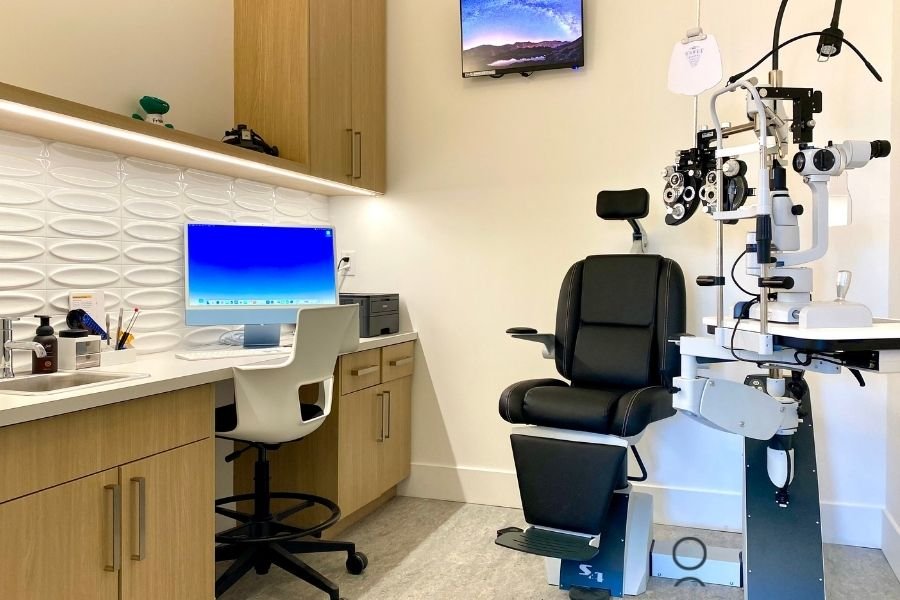
At Helio Optometry, we use advanced diagnostic technology and a personalized approach to myopia control, because no two children are the same. Early action can make a lifetime of difference.

Myopia Control Options at Helio Optometry
We customize treatment based on your child’s age, prescription, eye measurements, and lifestyle. Options may include:
Myopia control eyeglass lenses
Specialized soft contact lenses for myopia control
Prescription low-dose atropine eye drops
Ongoing monitoring and measurement of eye growth
As a privately owned Edmonton eyecare clinic, we select treatments based on clinical evidence, not brand limitations.
Discover Your Myopia Management Choices.
Why Families Choose Helio Optometry in Edmonton
Child-focused, education-driven care
Advanced myopia measurement and monitoring
Access to leading myopia control treatments
Locally owned, Edmonton-based clinic
Our optometry clinic anchors the communities of Crestwood, Parkview, West Jasper Place and Sherwood. Get your child started on a myopia management plan as soon as possible.
-
Myopia control is a relatively recent shift in how childhood nearsightedness is managed. For many years, myopia was treated primarily as a vision correction issue—meaning the focus was on prescribing glasses or contact lenses to see clearly, not on slowing progression.
In the last decade, research has significantly expanded our understanding of how myopia progresses and how excessive eye growth affects long-term eye health. As a result, new treatment options and clinical guidelines have emerged.
Not every clinic has adopted these newer approaches, invested in the necessary technology, or shifted their care model toward active myopia management. In some cases, families were simply told to “update the prescription as needed” because that was the standard approach at the time.
Today, we know more—and we can do more. At Helio Optometry, we focus on early detection, education, and evidence-based options to help reduce how much myopia progresses over childhood and adolescence.
-
Myopia control is often considered as soon as myopia is detected—especially between ages 6 and 10, when progression is typically fastest. Suitability depends on your child’s prescription, rate of change, eye measurements, and overall eye health.
-
Yes. Even low levels of myopia carry increased lifetime eye health risks. Starting myopia control early can help reduce how much myopia develops overall.
-
Myopia control treatments do not promise to stop myopia completely, but strong clinical evidence shows they can slow progression for many children. Slowing progression often means a child finishes adolescence with a lower prescription than they would have otherwise
-
Regular single-vision glasses correct blurred distance vision but do not slow the eye growth that drives myopia progression. Myopia control typically requires specific lens designs, contact lens technologies, or prescription eye drops intended to slow progression.
-
Follow-up schedules vary by treatment type and risk profile, but myopia control typically involves more frequent monitoring than routine eye exams. Regular visits allow us to track prescription changes, eye growth, and overall eye health. Most children are followed every 4-6 months.
-
If treatment is stopped, myopia may begin progressing again. Any changes should be discussed with your optometrist so we can adjust the plan safely.
-
Healthy visual habits are important, but when myopia is progressing, lifestyle changes alone are usually not enough. They work best as part of a comprehensive management plan.
-
Yes. When properly prescribed and monitored, myopia control is considered safe and is supported by extensive clinical research. Treatments such as myopia-control glasses, specialized contact lenses, and low-dose atropine eye drops have been shown to slow myopia progression safely in children when supervised with regular follow-ups.